Nuclear Security Profession Career Framework

This work has been produced with funding from the Department for Energy Security and Net Zero (DESNZ) in support of the UK Alpha Resilience and Capability (ARC) Programme. ARC is a proactive, long-term collaboration between the UK government, nuclear industry and wider nuclear sector which seeks to identify targeted projects and investments in specialist nuclear skills, expertise and facilities. 
Introduction

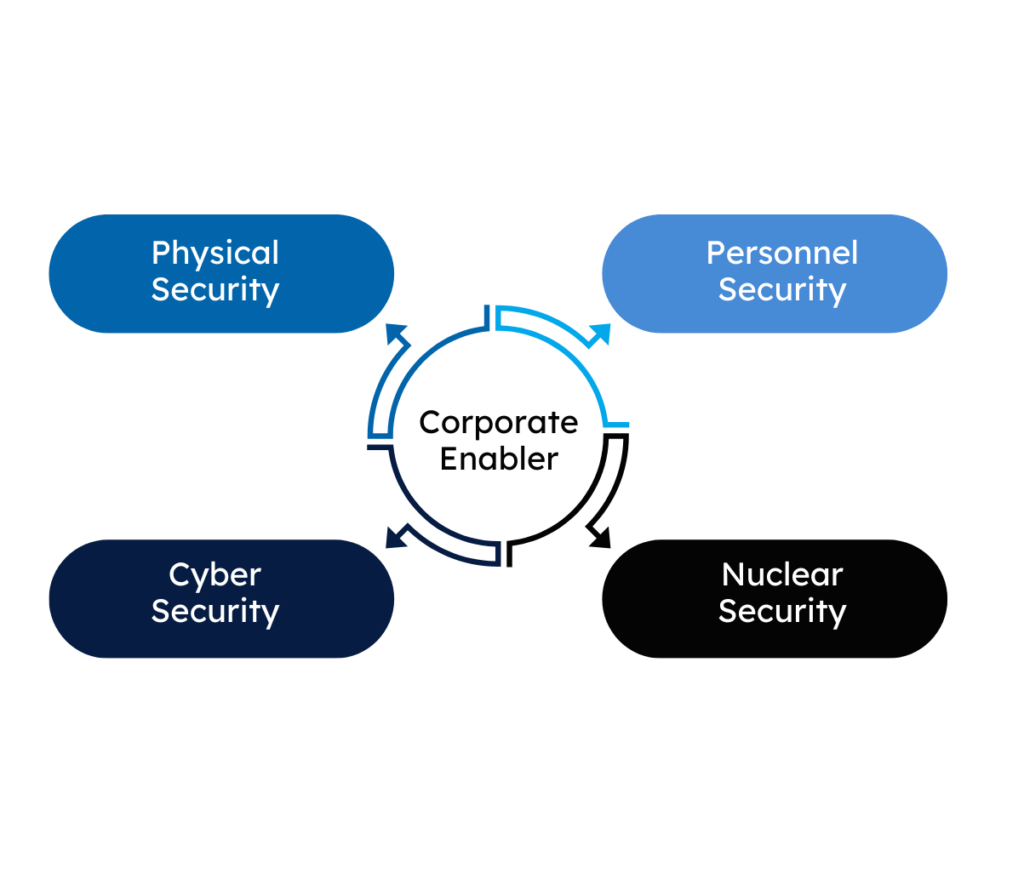
This document was prepared by the Security Sub Working Group (SSWG) on behalf of the Safety Directors’ Forum.  SSWG’s intention is to build the capacity and capability of security professionals working in the civil nuclear sector, covering Physical, Personnel, Nuclear Technical Security and Corporate Enablers (1). We aim to: 

  • Attract and recruit the best talent into the civil nuclear sector 
  • Retain a responsive, highly skilled and motivated workforce 
  • Develop a clear learning offer with external accreditation and interchange within the industry 
  • Support and align career pathways across the profession and wider industry 
  • Ensure future talent pipelines including via apprenticeships and graduate schemes within the nuclear sector

This document is based closely on the Government Security Profession Career Framework.  It should be used as a point of reference when: 

  • Identifying the required skills and experience when organisations are looking to recruit into a new role 
  • When employees are considering a role move 
  • During regular performance reviews, and 
  • When drafting a personal development plan 

Useful References 

This document should be read in conjunction with the following: 

  • Government Physical Security Curriculum and Brochure, April 2022 
  • Government Personnel Security Curriculum, February 2022 
  • Government Technical Security Learning Pathways and Curriculum Brochure, May 2022 

(1) Cyber Security professionals have already adopted the Chartered Institute of Information Security (CIISec) framework, therefore cyber security roles are not included in this document.

Nuclear Security Skills Framework

The Nuclear Security Profession Skills Framework describes the range of competencies expected of Nuclear Security professionals in the effective performance of their roles.  It has been developed with reference to the Government Security Profession Career Framework2, which groups skills into the following specialisms: Physical Security, Personnel Security, Cyber Security and Corporate Enablers.  Those skills which are unique to the civil nuclear sector are identified as a separate Nuclear Security specialism. 

This framework seeks to define the skills and capability expected of nuclear security professionals in practical application and not just an assessment of the knowledge.  Not all roles require detailed experience in all competency areas.   

What Are Skills

Skills refer to the expertise or aptitude in a capability that is needed to do somethingThe security skills are used to indicate the typical knowledge and experience required for each of the nuclear security roles in the career framework. 

What are they for?

The security skills are for everyone in the civil nuclear sector working in a security role, or anyone who wants to find out what is required for different nuclear security roles. 

How do I use the skills framework?

It is important to link the skills to your development and use them to inform career and development discussions with your managerThis will help you to agree which development areas to focus on. 

Remember the following:

  • The skill profiles are for guidance only and should not be used as an exact measure for a particular role 
  • Achieving the skill profile for a role at a different grade level does not entitle someone to that grade, but it may enhance their chances when applying for that role 
  • You do not need to achieve all aspects of the skill profile for a role before you can apply for it – we often learn best by stretching ourselves to take on new responsibilities 
  • Skill levels are cumulative – for example, to hold a ‘practitioner’ level in any skill, you must meet the requirements of ‘working’ level as well 
  • Examples of training courses in this document are for illustrative purposes only and are not endorsed by the Nuclear Security Directors Forum, ONR or DESNZ 

What are Suitably Qualified and Experienced Personnel?

Suitably Qualified and Experienced Personnel (SQEP) are integral to maintaining high standards within any Career Framework, ensuring that individuals possess the requisite skills, qualifications, and experience for their roles. This framework establishes clear criteria for identifying SQEP by aligning qualifications, certifications, and professional experience with specific competency levels and job requirements. This approach promotes consistency, enabling organisations to match personnel effectively to responsibilities and foster confidence in their capabilities.

Additionally, SQEP designation highlights pathways for growth, encouraging individuals to build on their existing expertise through ongoing professional development and advanced training opportunities. While technical qualifications and experience are essential, the framework also emphasises the importance of soft skills, such as communication, teamwork, and adaptability, fostering a well-rounded workforce capable of thriving in dynamic environments. Ultimately, SQEP contributes to a robust and dynamic career framework that values both current proficiency and future potential. 

Security Specialisms

The Nuclear Security Profession career framework has four security specialisms, plus Corporate Enablers:  

  • Personnel
  • Physical
  • Nuclear Specialist
  • Cyber


Physical security protects assets, including people, services, infrastructure, systems, places, equipment and networks. Effective physical security is achieved by multilayering different measures, which is commonly referred to as defence in depth. The concept is based on the principle that the security of an asset is not significantly reduced with the loss of any single layer. 

Role Family Role Family Definition
Advisory
Advisory Responsible for providing physical security advice and assurance within the organisation and externally within the civil nuclear sector.
Operations
Responsible for the efficient and effective management of all aspects of physical security operations, including outsourced capability (e.g. services and people) of physical and personal security from the places where people work and the people themselves, to the locations of systems, services and networks.
Research, Development & Design
Responsible for research and knowledge development of physical security countermeasures and associated guidance.

Personnel security is a system of policies and procedures that seeks to identify, understand and mitigate the risk of workers (insiders) exploiting their legitimate access to an asset for unauthorised purposes. 

Role Family Role Family Definition
Advisory
Responsible for providing personnel security advice and assurance within the organisation and externally within the civil nuclear sector.
Operations
Possible for conducting and facilitating people screening, implementing, reviewing and assessing security monitoring policies and investigating breaches or incidents of concern.
Research, Development & Design
Responsible for research and knowledge development of personnel security countermeasures and associated guidance.

Cyber security protects information systems (hardware, software and associated infrastructure), the data on them, and the services they provide, from unauthorised access, harm or misuse. This includes harmed caused intentionally by the operator of the system, or accidentally, or as a result of failing to follow security procedures.

For further details on cyber security roles and skills, please refer to the Chartered Institute of Information Security.

Role Family Role Family Definition
Advisory
Responsible for advising and enabling teams to make security decisions. This includes providing advice and guidance about technical matters and the identification of cyber related risks, and how to mitigate and manage risks.
Operations
Responsible for monitoring, responding to and proactively managing threats facing the organisation, including by monitoring event data, collecting and disseminating actionable intelligence, and managing identified vulnerabilities across the organisation.
Research, Development & Design
Responsible for ensuring development and design of applications is done with sensitivity to threats facing the organisation, and building security in the development process. This includes, for example, conducting penetration tests and social engineering tests.

Responsible for identifying and proposing mitigations against security risks relating to nuclear materials, including identifying effective countermeasures, while ensuring that mitigations are aligned to the expectations of nuclear industry regulators and legislative requirementsThis includes the protection of nuclear materials whilst in transit. 

Role Family Role Family Definition
Advisory
Responsible for identifying and mitigating security risks relating to nuclear materials, including ensuring the appropriate implementation of effective countermeasures, while ensuring that mitigations are aligned to the expectations of nuclear industry regulators and legislative requirements.
Operations
Responsible for delivering the protection of nuclear materials and associated technology from close access acquisition or sabotage by hostile actors.
Research, Development & Design
Responsible for research and knowledge development of nuclear security countermeasures and associated guidance.

The career framework also has Corporate Enablers. Corporate Enablers span the specialisms and are pivotal to the growth, development and success of the nuclear security profession. Individuals working in a corporate enabler role may belong to more than one nuclear function or profession. The corporate enablers included in the career framework are leadership, business continuity, education and awareness, training, capability development, policy, process, support, and risk management. 

Role Family Role Family Definition
Advisory
Responsible for identifying and mitigating security risks relating to nuclear materials, including ensuring the appropriate implementation of effective countermeasures, while ensuring that mitigations are aligned to the expectations of nuclear industry regulators and legislative requirements.
Operations
Responsible for delivering the protection of nuclear materials and associated technology from close access acquisition or sabotage by hostile actors.
Research, Development & Design
Responsible for research and knowledge development of nuclear security countermeasures and associated guidance.

Skill Level Definitions

Role Profiles are outlined in detail at Appendix 1.

  • Awareness *
  • Working **
  • Practitioner ***
  • Expert ****


Applies knowledge and experience of the skill, including tools and techniques, adopting the most appropriate for the environment 

Applies knowledge and experience of the skill with others, including tools and techniques, adopting the most appropriate for the environment 

Shares knowledge and experience of the skill with others, including tools and techniques, defining those most appropriate for the environment 

Has knowledge and experience in the application of this skillIs a recognised specialist and adviser in this skill including user needs, generation of ideas, methods, tools and leading or guiding others in best practice use

Nuclear Security Role Profiles

The Nuclear Security Profession roles are broken down into 4 role levels: entry level, associate, lead and principal. As the role level increases, the expectation on the individual increases, along with the number and complexity of skills associated with the role. In addition, the senior roles are required to support the development of junior roles and their departments through coaching, management and strategic planning. 

Role Profiles are outlined in detail at Appendix 2.

  • Entry Level *
  • Associate **
  • Lead ***
  • Principal ****

Entry level focuses on building a foundation of knowledge and skills aligned with a role. It is focused on increasing awareness of best practise, acknowledging the tools and techniques required to progress. This is also the primary entry point for apprentices and graduates. 

The Associate level focuses on developing knowledge and skills aligned with the role that were built at the entry level, including being able to utilise technical tools and techniques. It's also focused on increasing confidence and independence in the role, and sporting and working with others.

The Lead level begins to take the experiences at Associate level and shares this knowledge with others. Individuals at a Lead level will be expected to utilise the appropriate techniques and make decisions on project and programme levels.

Principal level individuals are considered experts in their field. They have a wealth of knowledge and experience in their security role, and are often expected to advise on the strategic decisions that involve their role within the department.

Training & Qualifications 

The wide variety of qualifications and suppliers is difficult to navigate.  Training providers are often deliberately vague when explaining the level of their courses, allowing buyers to make assumptions that are very often wrong.  The aim of this section is to explain the types of qualification which are available to those within the nuclear security profession, drawing a distinction between regulated and non-regulated qualifications. 

Regulated Qualifications Framework

The Regulated Qualifications Framework (RQF) is a system that provides a way to understand and compare the level and size of different qualifications. Each qualification level4 represents a progression in skills, knowledge, and understanding. The RQF allows learners, employers, and educational institutions to understand where a qualification sits in relation to other qualifications and gives a clear overview of progression pathways. 

Regulated Qualifications Framework (RQF) Levels Qualification Example
RQF Level 8
DOCTORATE
RQF Level 7
MASTER’S DEGREE
RQF Level 6
UNDERGRADUATE DEGREE
RQF Level 5
HIGHER NATIONAL DIPLOMA
RQF Level 4
HIGHER NATIONAL CERTIFICATE
RQF Level 3
A LEVEL
RQF Level 2
GCSE – GRADE 4 TO 9
RQF Level 1
GCSE – GRADE 1, 2, 3

Non-Regulated Qualifications

A non-regulated qualification is a course that is not benchmarked against the Regulated Qualifications Framework (RQF) and has not been validated by either Ofqual or the Quality Assurance Agency for Higher Education (QAA).  These courses can be used for professional and personal development, but universities do not recognise them for admissions.  That said, the merits of the training can still be compelling and of great value, but organisations should complete their own due diligence on the value of the learning content and credibility of the supplier. 

Nuclear security training and qualifications are outlined in detail at Appendix 1, matched against relevant Skills. 

Legacy Qualifications

Legacy qualifications will be integrated into the career framework to recognise the value of previous achievements and ensure equitable career progression. By mapping legacy qualifications to current competency standards, individuals can demonstrate how their prior certifications align with the framework's requirements. This approach provides clarity for transitioning professionals, validating their skills and knowledge without requiring requalification. Additionally, legacy qualifications can serve as foundational milestones within the framework, paving pathways for further development and advancement. Emphasizing inclusivity, the career framework will honour these qualifications while supporting lifelong learning and skill enhancement.

Sources of Security Training & Development

There are a wide variety of organisations offering security training. The most common sources of training within the civil nuclear sector are signposted within the Skills Framework. They include the following organisations:

  • National Protective Security Authority
  • Emergency Planning College
  • Business Continuity Institute
  • The Security Institute
  • American Society for Industrial Security
  • The World Institute for Nuclear Security
  • International Atomic Energy Agency
  • International Security Management Institute
  • Register of Chartered Security Professionals
  • Office for Nuclear Regulation
  • DISA - formerly The Defence Industry Security Association

National Protective Security Authority

NPSA offers a variety of training programmes aimed at enhancing physical and personnel protective security: 

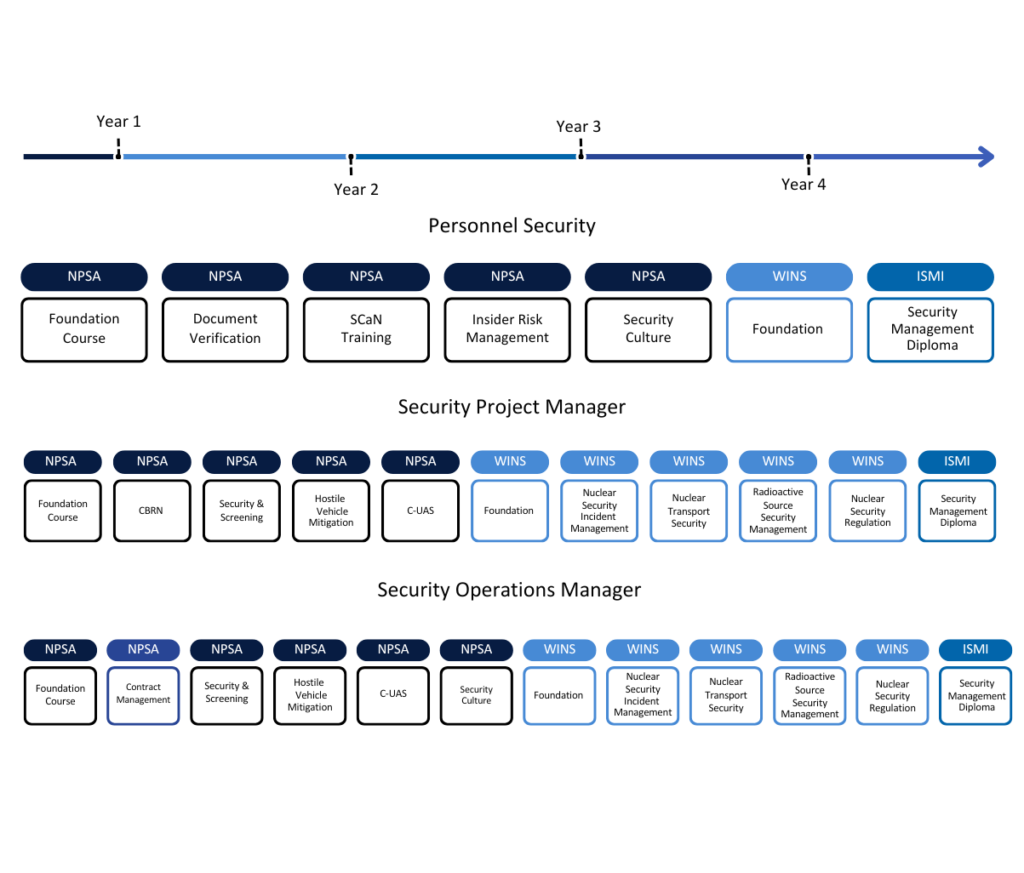
  • Digital Learning for Extranet Users: Foundation Course in Protective Security; Document Verification; Introduction to STaMP; Recognising IEDs; Insider Risk Management; Search & Screening; Security Culture; See Check & Notify (SCaN); Hostile Vehicle Mitigation 
  • In Person Learning: NPSA Foundation Course; Hostile Vehicle Mitigation; Counter Uncrewed Aerial Systems 

Emergency Planning College 

Note that from April 2025, EPC will change its name to the “UK Resilience Academy

EPC offers a wide range of resilience training courses designed to support individuals, teams, and organisations in preparing for and managing emergencies and crises. Some of their notable courses include: 

  • Writing Contingency Plans 
  • Debriefing Emergencies and Exercise 
  • Preparing Emergency Plans for COMAH 
  • Introduction to Crowd Safety Management 
  • Exercising Crisis and Business Continuity Plans 
  • Risk Management in Civil Protection 

Business Continuity Institute 

The Business Continuity Institute (BCI) provides a comprehensive range of training and development programs aimed at enhancing business continuity and resilience. Some of their key offerings include: 

  • Certificate of the Business Continuity Institute (CBCI) 
  • Introduction to Operational Resilience 
  • Stakeholder Engagement Training 
  • Emergency & Crisis Communications 

BCI also offers various webinars, reports, and thought leadership content to support ongoing professional development. 

The Security Institute 

The Security Institute offers a variety of training and development opportunities aimed at enhancing the skills and knowledge of security professionals. Some of their key offerings include: 

  • Continuing Professional Development (CPD) Scheme: This scheme encourages members to engage in ongoing learning and development activities to maintain and enhance their professional competence 
  • External Courses and Qualifications: The Security Institute collaborates with various universities and educational providers to offer a range of vocational and academic courses. For example, they work with Buckinghamshire New University and the University of Portsmouth to provide courses in risk and security management 
  • Mentoring Scheme: This program pairs less experienced members with seasoned professionals to provide guidance, support, and knowledge sharing. 
  • Networking Events and Conferences: The Institute organizes events that allow members to network, share knowledge, and stay updated on industry trends and best practices 
  • Webinars and Workshops: These sessions cover a wide range of topics relevant to the security industry, providing members with opportunities to learn from experts and engage in discussions 
  • Validation of Experience: The Institute offers a robust validation process for its members, ensuring that their experience and qualifications are recognized and valued within the industry. 

These opportunities are designed to support the professional and personal development of security professionals at all stages of their careers. 

American Society for Industrial Security 

ASIS International offers a wide range of training and development opportunities for security professionals. Here are some of their key offerings: 

  • Certification Preparation: ASIS provides comprehensive resources to help professionals prepare for their certification exams, including online review courses, flash cards, virtual study groups, and practice tests 
  • Certificate Courses: These courses focus on specific topics within the security field, helping both newcomers and experienced professionals build competencies in areas such as physical security, risk management, and information security. 
  • Webinars: ASIS hosts live and on-demand webinars covering a variety of topics relevant to security professionals, such as enterprise security risk management (ESRM), physical and operational security, and the integration of physical and cyber security. 
  • Career HQ: This platform offers career resources, mentorship programs, and job opportunities to help security professionals expand their career horizons and improve their skills. 
  • Professional Development Programs: ASIS provides access to a range of professional development sessions from their Global Security Exchange (GSX) event, covering topics like leadership, career planning, and mental health and wellbeing. 

These opportunities are designed to support the continuous professional development of security professionals, helping them stay current with industry trends and best practices.

The World Institute for Nuclear Security 

WINS offers a variety of training and development opportunities aimed at enhancing nuclear security. Here are some of their key offerings: 

  • WINS Academy: Certified professional development program for individuals responsible for nuclear security management. It includes various modules covering topics such as nuclear security governance, physical protection, and cybersecurity. 
  • Workshops and Training Courses: WINS organizes professionally facilitated workshops and training courses that provide excellent learning and peer-to-peer networking opportunities. These events cover a wide range of topics, including supply chain security, cybersecurity in the nuclear industry. 
  • Short Training Courses: These courses combine the flexibility of online learning with the advantages of social learning. They bring together a small cohort of learners to discuss course material and network with each other. 
  • Knowledge Centre: WINS members have access to an extensive archive of information on nuclear security, including best practice guides and special reports. 
  • Evaluation Services: WINS offers evaluation services to help licensees assess the maturity of their security programs and measure the effectiveness of their security culture. 
  • Scholarships: WINS provides scholarships to individuals who wish to enroll in the WINS Academy, with a focus on women and individuals from official development assistance (ODA) countries. 

These opportunities are designed to improve the professionalism and competence of those involved in nuclear security, ensuring that nuclear and radioactive materials are protected against threats. 

International Atomic Energy Agency 

IAEA offers a variety of training and development opportunities for nuclear security professionals. Here are some of their key offerings: 

  • Nuclear Security Training and Demonstration Centre (NSTDC): This centre provides hands-on training in critical areas such as physical protection of nuclear facilities, nuclear forensics, and cybersecurity. It aims to strengthen countries' abilities to tackle nuclear terrorism and address unique challenges 
  • Training Courses and Workshops: The NSTDC offers a range of courses and workshops, including: 
  • Physical Protection Equipment Installation, Integration, Operation, and Maintenance 
  • Central Alarm Station Design and Operation 
  • Insider Threats Training 
  • Nuclear Security Threat Assessment Methodology 
  • E-Learning Modules: The IAEA provides e-learning modules that introduce various aspects of nuclear security. These modules complement face-to-face training and support efforts to ensure competence, skills, and a strong nuclear security culture. 
  • Train-the-Trainers Courses: These courses are designed to equip subject-matter experts with the skills needed to train others in areas such as radiological crime scene management and contingency response planning. 

These opportunities are designed to enhance the professionalism and competence of those involved in nuclear security, ensuring effective protection against threats. 

International Security Management Institute 

ISMI offer a Certified Security Management Professional (CSMP®) Level 6 Accredited DiplomaThis programme is designed for security management professionals and covers advanced concepts in corporate security management. 

Register of Chartered Security Professionals 

Becoming a Chartered Security Professional (CSyP) involves a rigorous process to ensure you meet high standards of competence and commitment in the field of security. Here are the key steps: 

  • Educational Qualifications: You need a university degree in a security-related discipline or an equivalent qualification recognized by the Chartered Security Professionals Registration Authority. 
  • Operational Experience: You must have at least five years of operational security experience, with at least two years at the Chartered competence level. 
  • Application Process: Submit an application to the Register of Chartered Security Professionals, which includes demonstrating your competencies in security knowledge, practical application, communication, leadership, and personal commitment. 
  • Assessment: Your application will be reviewed by independent assessors who verify your strategic impact and competencies. 
  • Interview and Presentation: You will need to pass an interview and presentation to further demonstrate your skills and knowledge. 
  • Continuous Professional Development (CPD): Once certified, you must comply with a Code of Professional Conduct and complete CPD each year to maintain your status. 

Training is primarily for those within independent assurance functions.

DISA

DISA acts as a collective representative body interacting with HM government and agencies within the UK defence/security arena. DISA offers an extensive training program prepared and delivered by experts who are members of the organisation, including: 

  • Security Vetting & Personnel Security 
  • Facility Security Controller 
  • IT and Cyber Security 
  • National Protective Security Authority
  • Emergency Planning College
  • Business Continuity Institute
  • The Security Institute
  • American Society for Industrial Security
  • The World Institute for Nuclear Security
  • International Atomic Energy Agency
  • International Security Management Institute
  • Register of Chartered Security Professionals
  • Office for Nuclear Regulation
  • DISA - formerly The Defence Industry Security Association

National Protective Security Authority

NPSA offers a variety of training programmes aimed at enhancing physical and personnel protective security: 

  • Digital Learning for Extranet Users: Foundation Course in Protective Security; Document Verification; Introduction to STaMP; Recognising IEDs; Insider Risk Management; Search & Screening; Security Culture; See Check & Notify (SCaN); Hostile Vehicle Mitigation 
  • In Person Learning: NPSA Foundation Course; Hostile Vehicle Mitigation; Counter Uncrewed Aerial Systems 

Emergency Planning College 

Note that from April 2025, EPC will change its name to the “UK Resilience Academy

EPC offers a wide range of resilience training courses designed to support individuals, teams, and organisations in preparing for and managing emergencies and crises. Some of their notable courses include: 

  • Writing Contingency Plans 
  • Debriefing Emergencies and Exercise 
  • Preparing Emergency Plans for COMAH 
  • Introduction to Crowd Safety Management 
  • Exercising Crisis and Business Continuity Plans 
  • Risk Management in Civil Protection 

Business Continuity Institute 

The Business Continuity Institute (BCI) provides a comprehensive range of training and development programs aimed at enhancing business continuity and resilience. Some of their key offerings include: 

  • Certificate of the Business Continuity Institute (CBCI) 
  • Introduction to Operational Resilience 
  • Stakeholder Engagement Training 
  • Emergency & Crisis Communications 

BCI also offers various webinars, reports, and thought leadership content to support ongoing professional development. 

The Security Institute 

The Security Institute offers a variety of training and development opportunities aimed at enhancing the skills and knowledge of security professionals. Some of their key offerings include: 

  • Continuing Professional Development (CPD) Scheme: This scheme encourages members to engage in ongoing learning and development activities to maintain and enhance their professional competence 
  • External Courses and Qualifications: The Security Institute collaborates with various universities and educational providers to offer a range of vocational and academic courses. For example, they work with Buckinghamshire New University and the University of Portsmouth to provide courses in risk and security management 
  • Mentoring Scheme: This program pairs less experienced members with seasoned professionals to provide guidance, support, and knowledge sharing. 
  • Networking Events and Conferences: The Institute organizes events that allow members to network, share knowledge, and stay updated on industry trends and best practices 
  • Webinars and Workshops: These sessions cover a wide range of topics relevant to the security industry, providing members with opportunities to learn from experts and engage in discussions 
  • Validation of Experience: The Institute offers a robust validation process for its members, ensuring that their experience and qualifications are recognized and valued within the industry. 

These opportunities are designed to support the professional and personal development of security professionals at all stages of their careers. 

American Society for Industrial Security 

ASIS International offers a wide range of training and development opportunities for security professionals. Here are some of their key offerings: 

  • Certification Preparation: ASIS provides comprehensive resources to help professionals prepare for their certification exams, including online review courses, flash cards, virtual study groups, and practice tests 
  • Certificate Courses: These courses focus on specific topics within the security field, helping both newcomers and experienced professionals build competencies in areas such as physical security, risk management, and information security. 
  • Webinars: ASIS hosts live and on-demand webinars covering a variety of topics relevant to security professionals, such as enterprise security risk management (ESRM), physical and operational security, and the integration of physical and cyber security. 
  • Career HQ: This platform offers career resources, mentorship programs, and job opportunities to help security professionals expand their career horizons and improve their skills. 
  • Professional Development Programs: ASIS provides access to a range of professional development sessions from their Global Security Exchange (GSX) event, covering topics like leadership, career planning, and mental health and wellbeing. 

These opportunities are designed to support the continuous professional development of security professionals, helping them stay current with industry trends and best practices.

The World Institute for Nuclear Security 

WINS offers a variety of training and development opportunities aimed at enhancing nuclear security. Here are some of their key offerings: 

  • WINS Academy: Certified professional development program for individuals responsible for nuclear security management. It includes various modules covering topics such as nuclear security governance, physical protection, and cybersecurity. 
  • Workshops and Training Courses: WINS organizes professionally facilitated workshops and training courses that provide excellent learning and peer-to-peer networking opportunities. These events cover a wide range of topics, including supply chain security, cybersecurity in the nuclear industry. 
  • Short Training Courses: These courses combine the flexibility of online learning with the advantages of social learning. They bring together a small cohort of learners to discuss course material and network with each other. 
  • Knowledge Centre: WINS members have access to an extensive archive of information on nuclear security, including best practice guides and special reports. 
  • Evaluation Services: WINS offers evaluation services to help licensees assess the maturity of their security programs and measure the effectiveness of their security culture. 
  • Scholarships: WINS provides scholarships to individuals who wish to enroll in the WINS Academy, with a focus on women and individuals from official development assistance (ODA) countries. 

These opportunities are designed to improve the professionalism and competence of those involved in nuclear security, ensuring that nuclear and radioactive materials are protected against threats. 

International Atomic Energy Agency 

IAEA offers a variety of training and development opportunities for nuclear security professionals. Here are some of their key offerings: 

  • Nuclear Security Training and Demonstration Centre (NSTDC): This centre provides hands-on training in critical areas such as physical protection of nuclear facilities, nuclear forensics, and cybersecurity. It aims to strengthen countries' abilities to tackle nuclear terrorism and address unique challenges 
  • Training Courses and Workshops: The NSTDC offers a range of courses and workshops, including: 
  • Physical Protection Equipment Installation, Integration, Operation, and Maintenance 
  • Central Alarm Station Design and Operation 
  • Insider Threats Training 
  • Nuclear Security Threat Assessment Methodology 
  • E-Learning Modules: The IAEA provides e-learning modules that introduce various aspects of nuclear security. These modules complement face-to-face training and support efforts to ensure competence, skills, and a strong nuclear security culture. 
  • Train-the-Trainers Courses: These courses are designed to equip subject-matter experts with the skills needed to train others in areas such as radiological crime scene management and contingency response planning. 

These opportunities are designed to enhance the professionalism and competence of those involved in nuclear security, ensuring effective protection against threats. 

International Security Management Institute 

ISMI offer a Certified Security Management Professional (CSMP®) Level 6 Accredited DiplomaThis programme is designed for security management professionals and covers advanced concepts in corporate security management. 

Register of Chartered Security Professionals 

Becoming a Chartered Security Professional (CSyP) involves a rigorous process to ensure you meet high standards of competence and commitment in the field of security. Here are the key steps: 

  • Educational Qualifications: You need a university degree in a security-related discipline or an equivalent qualification recognized by the Chartered Security Professionals Registration Authority. 
  • Operational Experience: You must have at least five years of operational security experience, with at least two years at the Chartered competence level. 
  • Application Process: Submit an application to the Register of Chartered Security Professionals, which includes demonstrating your competencies in security knowledge, practical application, communication, leadership, and personal commitment. 
  • Assessment: Your application will be reviewed by independent assessors who verify your strategic impact and competencies. 
  • Interview and Presentation: You will need to pass an interview and presentation to further demonstrate your skills and knowledge. 
  • Continuous Professional Development (CPD): Once certified, you must comply with a Code of Professional Conduct and complete CPD each year to maintain your status. 

Training is primarily for those within independent assurance functions.

DISA

DISA acts as a collective representative body interacting with HM government and agencies within the UK defence/security arena. DISA offers an extensive training program prepared and delivered by experts who are members of the organisation, including: 

  • Security Vetting & Personnel Security 
  • Facility Security Controller 
  • IT and Cyber Security 

Training & Develpment Pathway Examples

Abbreviations

Regulated Qualifications Framework (RQF) Levels Qualification Example
ARC
Alpha Resilience & Capability
ASIS
American Society for Industrial Security
BCM
Business Continuity Management
BTEC
Business & Technology Education Council
CIPD
Chartered Institute for Professional Development
CIISec
Chartered Institute of Information Security
CNI
Critical National Infrastructure
DESNZ
Department for Energy Security & Net Zero
DfT
Department for Transport
IAEA
International Atomic Energy Authority
Regulated Qualifications Framework (RQF) Levels Qualification Example
NCSC
National Cyber Security Centre
NPSA
National Protective Security Authority
ONR
Office for Nuclear Regulation
QAA
Quality Assurance Agency for Higher Education
RQF
Regulated Qualifications Framework
SDF
Safety Directors’ Forum
SQEP
Suitably Qualified & Experienced Personnel
SSWG
Security Sub Working Group
SyAPs
Security Assessment Principles
Regulated Qualifications Framework (RQF) Levels Qualification Example
ARC
Alpha Resilience & Capability
ASIS
American Society for Industrial Security
BCM
Business Continuity Management
BTEC
Business & Technology Education Council
CIPD
Chartered Institute for Professional Development
CIISec
Chartered Institute of Information Security
CNI
Critical National Infrastructure
DESNZ
Department for Energy Security & Net Zero
DfT
Department for Transport
IAEA
International Atomic Energy Authority
NCSC
National Cyber Security Centre
NPSA
National Protective Security Authority
ONR
Office for Nuclear Regulation
RQF
Regulated Qualifications Framework
SDF
Safety Directors’ Forum
SQEP
Suitably Qualified & Experienced Personnel
SSWG
Security Sub Working Group
SyAPs
Security Assessment Principles
QAA
Quality Assurance Agency for Higher Education

Appendices